Study details:
NIH funded
n=14 seniors from pool of 100
6 months regular exergaming/exercising
Mean age = 78 years
Control group
Group 1 = virtual cycle
Group 2 = play game while cycling
Results:
Improvements in both groups executive function including verbal memory and physical function
ExerGaming Points 2 Ponder (ExP2P)
Were they using the Espresso Bikes?
Did they use recumbent or traditional seated cycles?
Was the program and tension standardized for the group, or individually based on fitness levels?
Summary
I am looking forward to reading the full article to dig deeper into these results. Cay has been publishing for a long time and it's good to see these articles getting good press too.
Can teens get fitter by wearing a smart shirt? The EU Foundation Horizon 2020 is supporting SmartLife to test this hypothesis using a mobile app, exergame, and gamification features.
Exergaming Points to Ponder (ExP2P)
How many shirts will teens have?
Do the shirts have attachments to a detachable pod like (Sensoria)?
Does the shirt have to be synced to a mobile device at all times?
Will this be a RCT across multiple countries and age groups?
Will schools/classes be stratified according to socioeconomic status?
I think it would be great to have some North American comparison groups.
BTW - This sentence is music to my ears!
SmartLife project aims to create a mobile game that requires lower body movement, and is personalized by physiological feedback measured by smart textiles. To date, no serious games exist that personalize the game play by real-time feedback on achievement of the target behaviour. Personalization via smart textiles can present a game challenge achievable for the current fitness level of the player and can adjust this based on activity levels during game play. This approach can improve current exergames to achieve a higher level of intensity in physical activity, needed to create a health impact, and can do so taking into account what is achievable for the person and hence reduce drop-out and injury risks.
Energy-related behaviours (physical activity, sedentary behaviour) are main modifiable determinants of several non-communicable health conditions, e.g. diabetes type 2, overweight and obesity, and track into adulthood. Promoting these behaviours among youngsters can have great health and societal gains. Meeting recommended levels for these behaviours is especially low among adolescents, girls and those of lower socio-economic status. An intervention to promote energy related behaviours among adolescents is thus indicated, and may also address social inclusion. Exergames, which require movement to be played, have great yet underused potential to promote these behaviours. To fully utilise this potential, exergames need to promote moderate-to-vigorous physical activity; need to be tailored to the individual user; and need to be more engaging. The SmartLife project aims to create such an exergame. The SmartLife exergame will be:
A mobile game requiring lower body movements;
Combined with a smart textile that provides immediate physiological feedback (e.g. heartrate, respiration) and ensures exercises are performed at a moderate-to-vigorous intensity level;
Tailored to individual user’s needs, using the smart textile data, and based on available evidence and big data analysis;
Highly engaging, e.g. by adding a narrative and context information, and using user input throughout the design (‘participatory development’).
Connecting VR and fitness at home is exergaming customized to a user's preferences in physical activities. Kettler bikes have been moving this way previously with their cycling KETT app that has gamification features like social networks, leaderboards, and ride sharing features.
In this French news piece on VRexergaming combination, being immersed in your cycling environment could be a great way to feel more like you're actually there. The cycle when connected to your mobile device actually adjusts when going up and down hills so it feels more realistic.
Exergaming Points to Ponder (ExP2P)
Sweating with a head piece on would be fine for a few minutes, but I wonder how comfortable it'd be for more than 10 minutes or a really sweaty workout?
Can the straps be easily washed?
All we need is a fan to simulate some wind and we'd be in a near complete immersive environment.
I spotted this RCT trial from Taiwan that studied how much enjoyment university students had while playing the exergame Your Shape: Fitness Evolved for Xbox 360.
Sample: 337 participants (168 intervention group, 167 control group)
Population: Mean age 20 years
Methods: RCT, 2 sessions over 2 weeks, 30 minutes per session Measurements: vigor, happiness, and stress
Results: Intervention group had higher levels of vigor from the start to the end of the study. Exergaming Points 2 Ponder (ExP2P)
After playing YourShape: Fitness Evolved I still hold PS2 EyeToy Kinectic as the top of the whole body exergaming genre. Although it is a step up from the YourSelf Fitness (Wii), it still doesn't compare to actually seeing you actually moving and interacting with virtual objects (and without VR headsets).
I wonder if they (Sony) own the actual patent for that feature?
I wonder if we will ever see ourselves instead of an avatar?
To examine how playing exergames impacts the mood states of university students and staff, and whether such an impact depends on gender and players' previous exercise time. This study was designed as a randomized controlled trial. It enrolled 337 participants and randomly assigned them to an intervention group (n = 168) or a control group (n = 167). A 2-week exergame program was designed for the participants in the intervention group. They were required to play exergames for 30 consecutive minutes each week for 2 weeks and respond to the items measuring vigor, happiness, and perceived stress. All measures were administered before and after the study. Repeated measures analysis of variances were conducted. Playing exergames enhanced vigor and happiness for participants in the intervention group. This group exhibited more positive change in vigor and happiness than the control group. This effect of playing exergames was not moderated by gender, age, occupation (student or staff), or previous exercise time. Playing exergames may induce positive mood states among university students and staff.
Challenge your own footie skills with this #exergaming Kinect installation in time for the 2014 FIFA World Cup. Available in only 20 locations worldwide, if you are able to match the skills and get enough points in 30 seconds, you can earn a Pepsi.
Exergaming Points 2 Ponder
With many of these games, having a certain competency level prior to playing will translate to better in-game success, but if you are not as high-skilled or have low fitness levels, playing exergames (fitness video games) can be a frustrating experience.
If we are trying to build perceived competence, autonomy and relatedness - we need to ensure there are ways and game play mechanics that support these Self-Determination Theory principles.
The interactive vending machine allows customers to show off their soccer skills utilizing Microsoft Kinect technology, with no purchase necessary. Users can create an avatar with their name and begin earning points immediately. Throughout the interactive experience, fans are encouraged to keep the virtual football in the air for 30-seconds as they move through a series of skills challenges. Advanced players can earn bonus time and compete for "Hall of Fame" recognition at each location.
Danz Base was featured at the GTI Taipei 2014 Trade Show with the usual demo team of female dancers. This Chinese-based #exergame appears to be a 2-player game but can be linked to another machine (online?) to become a 4-player game.
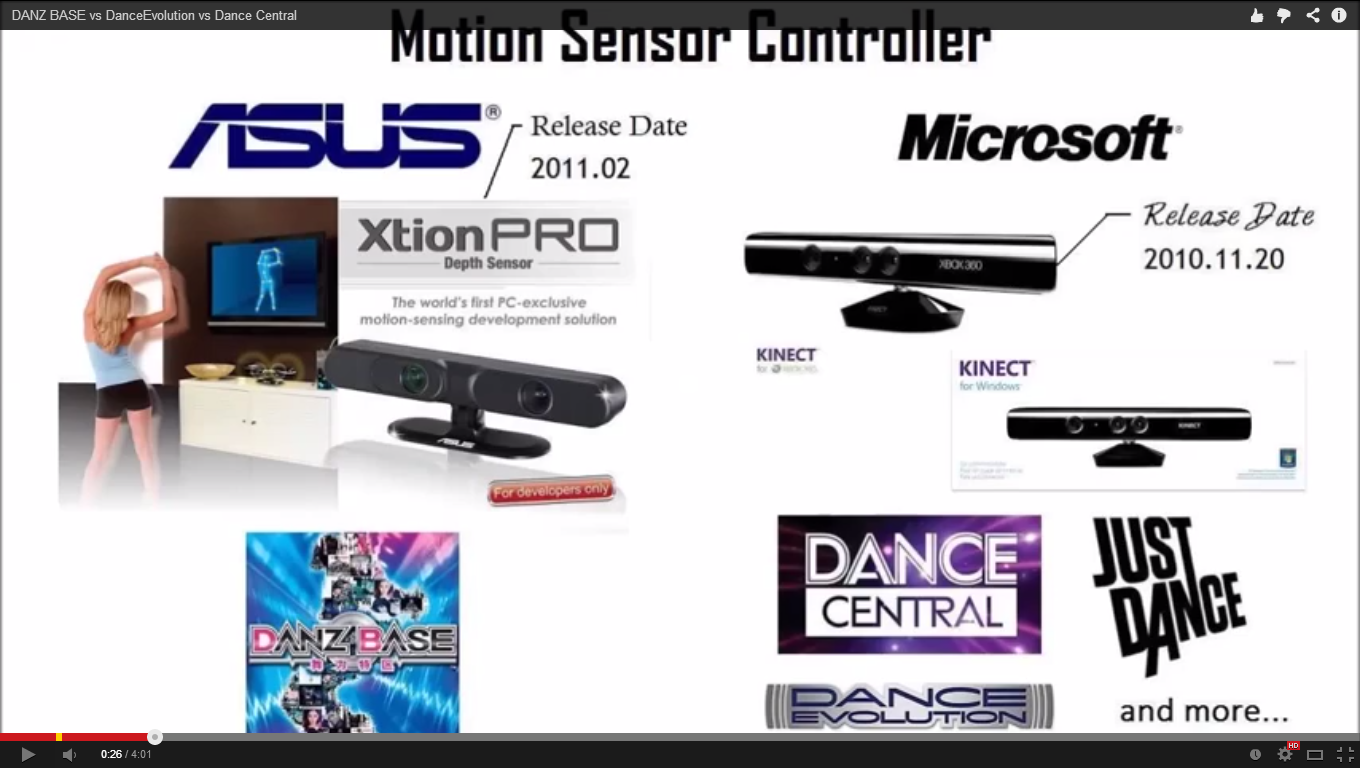
Similar to DanceEvolution (feturered previously) it uses a camera-based sensor to detect game player movement and award points and achievements. After watching the third embedded video, apparently they are using an ASUS Xtion PRO Depth Sensor while the other units (DanceEvolution & Dance Central) use the Kinect (both PC versions).
Features:
-Danz Base is a new and interactive two players’ somatosensory dance machine from IGS. The game features with motion sensing, interactive lights and double woofer functions, and 4 players are available to play a game at the same time through video with the Global Network function.
-Besides, the abundant music in this wonderful machine includes popular songs from all over the world, America, Europe, Korea, Japan and amount vast productions from China, fun for new beginners and experienced players.
-Danz Base with the unique ARKOPAZE system: based on lendon, offering players interactive service on multi machines, allows player to exchange award on other machines like Muzibox DJ when reach achievements on Danz Base.
Exergaming Points 2 Ponder (ExP2P)
Its clear from the videos, the dancers are are auto-generated or simply duplicated from the main dancer. Very different from the more complex motion-capture (high-res) dancers and multi-player sequences as seen in Just Dance.
I think their choice of using the term "somatosensory dance machine" interesting given that all video games are somatosensory (multiple senses) and this game is is primarily only visual and auditory.
According to the description on one of the distributor websites, Danz Base uses an ARKOPAZE system that will enable users to collect awards and use them on Muzibox DJ. Its too bad we don't see more interoperability between machines, gamer profiles, companies as game consoles. We're really missing out on the ability to share with details of our amazing dance conquests, perfect routines and overall fitness data.
In watching the 3rd video, gameplay footage clearly shows some interesting comparisons in providing feedback which I didn't pick up until they were placed side-by-side (see screenshot below). Besides the audio, Dance Central provides "visual" feedback at the point of the dance move (hands, hips, feet) whereas Dance Central only provides "visual" feedback but it rotates around the "virtual lead dancer" and is sometimes not visible. The other factor that makes visual feedback on Dance Central more cluttered is the cumulative score, and star levels nestled to the left of the "virtual lead dancer".
Concluding Thoughts
Using fitness video games can be a fun and engaging way to keep an active lifestyle fresh and entertaining. Remember if its not fun to do, you probably won't do it consistently and that's not a good thing. Fitness matters, and we need to find more ways to stay active and make healthy choices with food and emotion.
No word on whether or not we will see this arcade system in the US, but if you see one please let me know below in the comments or on Twitter @syangman
Fast-paced arcade #exergaming just got more rhythm with Neon FM by Unit E. With easy unlimited multi-player linking machines (not sure if there is remote / online linking), smartphone login via the Cardiac QR system, and a "Fail No More" leveling system that adjust for poor performances that won't end the game– but will automatically reduce the difficulty (Competence) while you’re playing. A mobile version is reportedly coming this spring 2014, keep your eye out for it.
I also love this feature that I haven't seen on other arcade machines:
Try before you buy Players can sample songs before they even put coins into the machine!
Reducing the level of difficulty in-game is a huge shift in game-play options as it is more likely to encourage those who find a level particularly difficult (especially for the beginners)
For those new to rhythm gaming, hand-eye coordination, audio/sound/rhythm coordination, anticipation, agility, and kinesthetic awareness are the primary skill-related and health-related fitness skills required to be successful.
Now I'm sure if we were to measure heart-rate and energy expenditure using NEON FM we would get the full-range from low, to moderate to vigorous intensities and this might be a little more strenuous than the typical motion gaming titles like Wii Sports (probably on par with Wii Boxing).
Concluding Thoughts
Exergaming especially when combined with extended periods of time can be beneficial to health outcomes like cardiovascular and muscular endurance. Along with coordinated rapid hand-eye movements and social interaction, video gaming can provide health benefits that "more than meets the eye"
Sega America released a free iOS mobile #exergame app called Go Dance in September 2013 but this weeks its free, so grab it before it goes back to $1.99. Using the iOS device camera and Extreme Reality's Extreme Motion SDK, Go Dance detects the players movements and awards points on how accurate the moves were to the game's sequence.
Exergaming Points @ Ponder (ExP2P)
One of the screenshots says that Go Dance is the world's first Dance game for iPhone, iPad, iPod Touch devices with cameras, but its not the only one. Konami released their version a while back called DDR Pocket Edition but instead of using the camera, the iOS device has to be held while dancing in order to detect steps roughly in time with the DDR arrows scrolling on screen.
Given the two different games, I would lean in favor of using the camera option with Go Dance as holding the device while danceing is just waiting for a disaster to happen...especially with students.
It would be great to use your own songs to dance to and choreograph your own moves like in Exergame Station.
Judging by the number of ratings, Sega Go Dance has nearly 1000 ratings whereas Konami's DDR Pocket Edition has only 13, it appears the "people have spoken".....especially considering Pocket Edition is a free app.
Check out after the jump for the rest of the screenshots.
Although not a new product from Konami, DanceEvolution ARCADE is essentially the same as the US Kinect Xbox-based Dance Masters exergame.
Exergaming Points 2 Ponder (ExP2P)
Not using a dance pad like DDR, it would seem playing the arcade and the console versions would be nearly identical. This is good because the moves and gameplay would be similar and easier to improve skill, stamina, and confidence.
Its clear from the videos, the dancers are are auto-generated or simply duplicated from the main dancer. Very different from the more complex motion-capture (high-res) dancers seen in Just Dance and Dance Central.
It appears that the arcade uses Kinect sensor, but I can't seem to find out for sure.
Can exergaming help children who have migraines without aura (MoA)? According to a recent study from a group of Italian authors published in Neuropsychiatric Disease and Treatment,playing the exergame Wii Fit over three months can improve measures of balance, coordination, motor tasks in children. Over 12 weeks, children (mean age: 9.13±1.94 years) played games that focused on antero-posterior (snowboarding); medio-lateral (skiing, penguin game, and soccer); and multidirectional weight shifting (bubble game and hula hoop) movements three times per week each for 30 minute sessions. Its good to read that participants were able to choose (autonomy) from 18 different games which likely increased levels of motivation and enjoyment (self-determination theory - SDT). Other games listed include: ski-jump, segway circuit, obstacle course, and skate boarding,ski-slalom, table tilt, snowboard slalom, Tilt City, and Rhythm. Exergaming Points 2 Ponder (ExP2P)
In the introduction, the authors stated that since many children with migraines suffer from "...emotional dysfunction, absenteeism from school, and poor academic performance, as well as issues relating to poor cognitive function, and sleep habits"... it would have been nice to see some of these measures tested in the study.
It appears that the control group used was a non-active group and many studies are now using active controls to better compare any group effects.
It would be interesting to see what impact other exergames that include more hand-eye coordination (Kinect Brain & Body Connection, EyeToy) as opposed to foot-eye/balance coordination (Wii Fit).
I would also wonder what more intense levels of physical activity (with a rhythm game like Dance Central or Just Dance) would do for cognitive function and mood in this population.
Concluding Thoughts
I love and have used a similar version of the following phrase in terms of using games for therapy "video game interventions can increase patient enjoyment and engagement, which may enhance compliance." What remains to be seen in many exergame studies are long term "lasting" effects. Unfortunately most children (and adults too) play games for a short amount of time and then end up switching games so we definitely see a novelty effect (or reactivity). I wonder how we could design experiments that are less dependent on a particular game and more focused on overall health or performance outcomes.
Esposito M, Ruberto M, Gimigliano F, Marotta R, Gallai B, Parisi L, Lavano SM, Roccella M, & Carotenuto M (2013). Effectiveness and safety of Nintendo Wii Fit Plus™ training in children with migraine without aura: a preliminary study. Neuropsychiatric disease and treatment, 9, 1803-10 PMID: 24453490
Abstract: Migraine without aura (MoA) is a painful syndrome, particularly in childhood; it is often accompanied by severe impairments, including emotional dysfunction, absenteeism from school, and poor academic performance, as well as issues relating to poor cognitive function, sleep habits, and motor coordination.
The study population consisted of 71 patients affected by MoA (32 females, 39 males) (mean age: 9.13±1.94 years); the control group consisted of 93 normally developing children (44 females, 49 males) (mean age: 8.97±2.03 years) recruited in the Campania school region. The entire population underwent a clinical evaluation to assess total intelligence quotient level, visual-motor integration (VMI) skills, and motor coordination performance, the later using the Movement Assessment Battery for Children (M-ABC). Children underwent training using the Wii-balance board and Nintendo Wii Fit Plus™ software (Nintendo Co, Ltd, Kyoto, Japan); training lasted for 12 weeks and consisted of three 30-minute sessions per week at their home.
The two starting populations (MoA and controls) were not significantly different for age and sex . M-ABC and VMI performances at baseline (T0) were significantly different in dexterity, balance, and total score for M-ABC and visual and motor tasks for VMI. After 3 months of Wii training (T1), MoA children showed a significant improvement in M-ABC global performance, M-ABC dexterity , M-ABC balance and VMI motor task.
Our study reported the positive effects of the Nintendo Wii Fit Plus™ system as a rehabilitative device for the visuomotor and balance skills impairments among children affected by MoA, even if further research and longer follow-up are needed.
Esposito M., Ruberto M., Gimigliano F., Marotta R., Gallai B., Parisi L., Lavano S.M., Roccella M. & Carotenuto M. Effectiveness and safety of Nintendo Wii Fit Plus training in children with migraine without aura: a preliminary study, Neuropsychiatric Disease and Treatment, 1803. DOI: 10.2147/NDT.S53853







.jpeg)
.jpeg)


