Erez Bar Am, an Industrial Design graduate from Shenkar College for Engineering and Design, Israel, conceived the “Radio Active” and I think it’s a neat way to get us up off the couch. According to the description, its an analog radio which requires you to physically move its strings in order to turn up the volume or change the station.
Wouldn’t It Be Cool (WIBC) to have solo, dual, group and even competitions of radio tuners. Imagine people tuning music and not just radio signals to put a song together or to even a musical throw-down competition. I’ve been playing with a few music apps on my IPod that allow you to put tracks together by throwing down, looping and sound efx. Check out GrooveMaker or Computer Music.
Bringing six degrees of freedom without the use of accelerometers, gyrometers, IR or LED sensors, Sixsense TrueMotion Controllers continues to impress game studios like Valve Studios (Left 4 Dead 2) as the game is being showcased with the TrueMotion controllers at CES 2010
I've featured the differences between TrueMotion Controllers and the W**'s MotionPlus before but the scene is getting more and more crowded with motion controlled gaming and PC peripherals. I will be highlighting a company from Taiwan that I
Unlike a Wiimote or Sixaxis controller, the TrueMotion controller operates within a weak magnetic field rather than relying upon accelerometer technology. The degree of accuracy falls to the nearest millimeter, and is updated once every ten milliseconds. This results in a fluid, highly accurate input device that could revolutionize PC and console gaming, as well as lead to some fascinating applications in the engineering design, industrial and medical fields.
Using a single transmitter with a six-foot radius range, Sixense TrueMotion can detect the position and gesture movement of controllers without a line-of-sight limitation. As long as the controllers are within the 12 foot diameter spherical magnetic field, it can detect their movement in space along six axes—a Sixense rep proved this by controlling a second tech demo with one hand behind his back.
The control set up that Sixense had implemented at Razer's CES booth used the left-handed TrueMotion controller for much of what the left hand side of a keyboard or controller would do. Angling the controller downward crouched, a flick upward performed a jump, a push forward shoved. It was also used to toss grenades. A flick of the controller left or right cycled through weapons, and after choosing the grenade, an overhand toss motion tossed that equipped item, in my case Boomer Bile.
The right hand controller controlled firing, camera control and melee weapon swings. It was a bit awkward at first, particularly for camera control and aiming, as Left 4 Dead 2 wasn't built with something like Sixense control in mind. But Valve has clearly been impressed by the technology, vowing support for TrueMotion controllers in games using its Source engine. Regardless of the learning curve, the motion control felt spot on, quick slices with the controller resulting in accurate slices on screen.
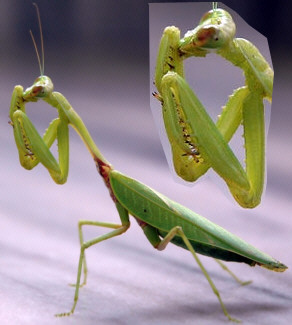
Getting our youngsters to move more is a major mission for most countries. Mexian Industrial designer Isabel Rico Avila (btw - I love www.Coroflot.com for inspirational designers) shows off her Mantis bike concept by positioning the rider in a forward leaning position while the hands control a two-wheeled front steering mechanism. Given the skyrocketing rates of youth overweight and sedentarism, we need to find new activities and solutions that are enjoyable and can be supported in multiple environments. Let's get a Gamercize unit on this baby and now we have a whole new way to play whatever game we want. Time for a little praying mantis action;)
Unveiled at CES 2010, the Samsung MyFit is a fitness oriented MP3 player with a few extra goodies to keep you moving and motivated. From the video and specs, it looks like it uses BIA (Bio-electrical impedance) to measure the your body-fat percent using a three site measurement protocol (much better than the cold metal calipers in our lab). It will also help manage...
stress etc. with the help of accelerometer, fat and stress sensors. It also comes with two additional applications like water intake manager and smoking cessation utility.[Samsung Hub]
Will it have prompts and programming to engage in exergames or active games? We'll see.
The uber-connected and original Floyd Mueller) has done it again. After going to China to work on some developments with Microsoft's ( perhaps Project Natal), we find this video of Dance at a Distance, which to me should be named "Body Beats at a Distance".
From this workshop, it appears they mapped EMG of player 1 to a matched player 2's EMG so that the electrical signals are transferred from player to player. This is more reminiscent of my fathers TENS (Transcutaneous Electrical Nerve Stimulation) acupuncture machines than dancing - but call me crazy.
This is a super-early prototype of an Exertion Game that came out of a workshop on Designing Exertion Games. The idea participants came up with was that distributed players can see each other over a videoconference, and, according to music, have to slap-dance to it in sync: to facilitate synchronicity, players get an electric muscle stimulation on the same body limb where the other player is hitting his/her body. This video shows a 1-way interaction how the technology could look like: a hit on one body sends an electronic shock to the other body.
Here's are some really innovative final concepts developed by Flo's students in his Exertion Games lecture last fall. Perhaps we will see one of these games developed in the near future.
Besides ITV, 3D TV, and e-readers, news of Project Natal has been spreading all week at CES 2010 and its "scheduled" 2010 Holiday release:
Some of the news is good
A few details about Project Natal's technical capabilities slipped out alongside the holiday 2010 release window at Microsoft's CES press conference. The most revealing of these specifics is that the hardware will only siphon 10 to 15 percent of the 360's CPU power, according to a statementfrom Natal lead developer Alex Kipman. "Natal has to work on the existing hardware without taking too much hardware processing away from the games developers," Kipman added.
However, according to a report obtained by GamesIndustry, the processing power could have been further reduced. The original build for Natal included a chip that processed the "bone system," assumed responsible for creating a skeleton of the player in front of the device's glossy eye. However, in an attempt to lower costs, the chip was removed from the device's final build, putting that processing onus on the software that will utilize Natal.
In other words, it's extremely unlikely that any software will be able to have Natal support patched into it -- a fact that Digital Foundry's Richard Leadbetter says could help "serve to focus developers on Natal-specific concepts as opposed to revisiting old classics."[Via Joystiq]
...and some of the news is not being so well-received...
If it is going to revolutionize how we interact with media, data, and games - and help get us up off the couches and move more....I'm all for it. Let's go!
The ExerGame Lab wishes everyone a Happy New Year and hopes that 2010 brings everyone a Monstrous year filled with hope, happiness, and health to you and your families.
Let's keep our collaborative efforts like The ExerGaming Network (TEN) and Games for Health 2010 going strong and make 2010 bigger and better than ever before. ExerGamers will be presenting at numerous conferences over 2010 (G4H, AAHPERD, GDC, APA, ACSM, CHI-SIG, and more) so be sure to update me on where you're presenting and we can support the Twitter back-channels by using the #exergame or #exergaming hastags on Twitter or folllow me at syangman or ExerGame Network.