What looks like a bulky female hygiene product is actually a health monitor that hooks up to an iPhone via Bluetooth, sending bodily information such as heart rates to the compatible app. More »
Wednesday, April 21, 2010
Raisin Health Monitor Sends Heart Rate Details To Your iPhone [IPhone Apps]
What looks like a bulky female hygiene product is actually a health monitor that hooks up to an iPhone via Bluetooth, sending bodily information such as heart rates to the compatible app. More »
Monday, April 19, 2010
More Active Cows = Healthier Cows + Healthier Earth
At one farm in Northern Ireland, cows are giving up green grass in favor of green power. In order to decrease his reliance on fossil fuels for electricity, farmer William Taylor created the Livestock Power Mill, a treadmill that generates power as cows walk on it. It may seem like a kooky idea, but Taylor could really be onto something: According to his calculations, if the world’s 1.3 billion cattle used treadmills for eight hours a day, they could produce six percent of the world’s power. Cows are locked into a pen on top of a non-powered, inclined belt. To avoid sliding down the incline, the cow needs to walk, which turns the belt. As the belt turns, it spins a gearbox, which powers a generator. A feed box hooked to the front of the device keeps cows occupied and happy. One cow can produce about two kilowatts of electricity, enough energy to power four milking machines.
It may seem cruel to make cows sweat it out on a treadmill, but the routine is actually quite similar to the animals’ normal behavior. Cows walk about eight hours a day while grazing. Doing that walking on a treadmill provides the same amount of exercise with the added bonus of renewable power production.
For now, the Livestock Power Mill is just a prototype on Taylor’s farm. But if the idea catches on, we could see farms all over the world employing the useful device. Taylor estimates that a small farm could earn back a 50-cow system’s $100,000 price tag in a mere three years.
Saturday, April 17, 2010
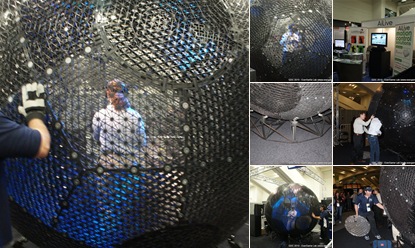
Virtusphere Brings 3D Whole-Body Immersion Gaming (GDC 2010)
Virtusphere from Binghamton, New York was demoing at GDC 2010 in San Francisco back in March and the line to try it out was busy both days I was able to get on the exhibition floor. I will be visiting their Binghamton office soon so I will have more to report over the summer. WIBC - I wonder if the movements are faster than a walking speed like running or more erratic movements like jumping, if the Virtusphere is still as effective. I wonder if the Virtusphere can be used along with a Wii, PS3, or Xbox360? Is it possible to use the newest wireless controllers that rely on magnetic fields (Sixense) or magnetometers (PS3 Move/Navigation Controller & Gametrak Freedom)?
How it works: Virtusphere consists of a 10-foot hollow sphere, which is placed on a special platform that allows the sphere to rotate freely in any direction according to the user’s steps. Wearing a wireless, head-mounted display the user is able to walk and run being immersed into virtual environment. The movement by the user is replicated within the virtual environment. The same hardware set can be used for different applications by changing only the software applications.
Friday, April 16, 2010
Health Games Research Database goes live
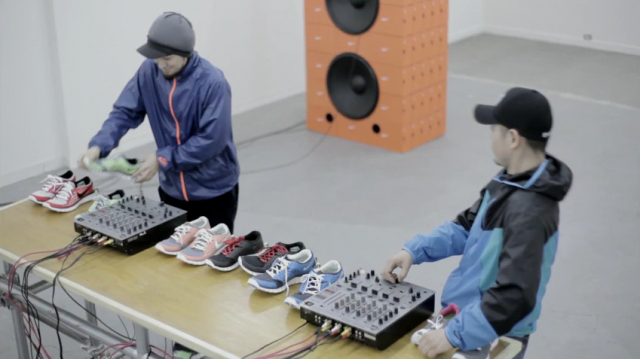
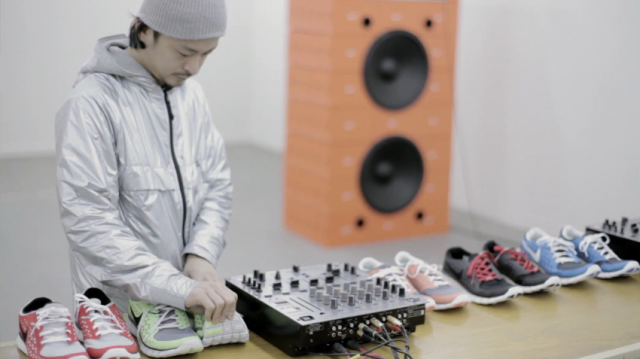
Nike Music Shoes: Music to My Body & Soul!
Tuesday, April 13, 2010
Multitoe or MultiToeTapping ExerGame (Concept)
We propose direct touch surfaces that are orders of magnitude larger than tabletops by integrating high-resolution multi-touch sensing into back-projected floors.
The key factor of the shown design is that it is based on frustrated total internal reflection sensing. FTIR allows it to identify and track users based on their sole patterns. The floor recognizes foot postures, distinguishes users who interact from people walking by, and enables high-precision interaction. In addition, the floor can approximate users' head positions based on the pressure profile in the soles and it extracts enough details from soles to allow users to play first person shooters by balancing their feet.
The shown work is a research project by Caroline Fetzer, Thomas Augsten, Konstantin Kaefer, Dorian Kanitz, Rene Meusel, and Thomas Stoff in the Human Computer Interaction Lab of Prof. Patrick Baudisch at Hasso Plattner Institute, Germany