Wednesday, October 5, 2011

Exergames in ICU

Feasibility and observed safety of interactive video games for physical rehabilitation in the intensive care unit: a case series
Background

Full-size image (50K) - Opens new windowEarly rehabilitation in the intensive care unit (ICU) improves patients' physical function. Despite reports of using commercially available interactive video game systems for rehabilitation, there are few data evaluating feasibility and safety as part of routine in-patient rehabilitation, particularly in the ICU.

Methods
We conducted an observational study from September 1, 2009, to August 31, 2010, of adults admitted to a 16-bed medical ICU receiving video games as part of routine physical therapy (PT), evaluating use and indications and occurrence of 14 prospectively monitored safety events.

Results
Of 410 patients receiving PT in the medical ICU, 22 (5% of all patients; male, 64%; median age, 52 years) had 42 PT treatments with video games (median [interquartile range] per patient, 1.0 [1.0-2.0]). Main indications for video game therapy included balance (52%) and endurance (45%), and the most common activities included boxing (38%), bowling (24%), and balance board (21%). Of 42 treatments, 69% occurred while standing and 45% while mechanically ventilated. During 35 hours of PT treatment, 0 safety events occurred (95% upper confidence limit for safety event rate, 8.4%).

Conclusions
Novel use of interactive video games as part of routine PT in critically ill patients is feasible and appears safe in our case series. Video game therapy may complement existing rehabilitation techniques for ICU patients.

Keywords: Rehabilitation; Critical care; Adults; Mechanical ventilation; Interactive video games

Michelle E. Kho PT, PhD, Abdulla Damluji MBChB, MPH, Jennifer M. Zanni PT, MSPT, ScD, Dale M. Needham MD, PhD


Click here to explore more of ExerGame Lab's archived posts involving research studies. 
Enhanced by Zemanta

Tuesday, September 20, 2011

Tetris on DDR Pads (StepTet)

Bravo to another great MIT crew project! I love the 6 foot LED matrix and the mash-up of games but I think a more serious workout would occur if you had to move further like on a Lightspace floor or you had to lift weights while playing like in Tetris Weightlifting.


Tetris Game Controlled with DDR Pads, DDT is Born - Technabob:
'via Blog this'

Monday, August 15, 2011

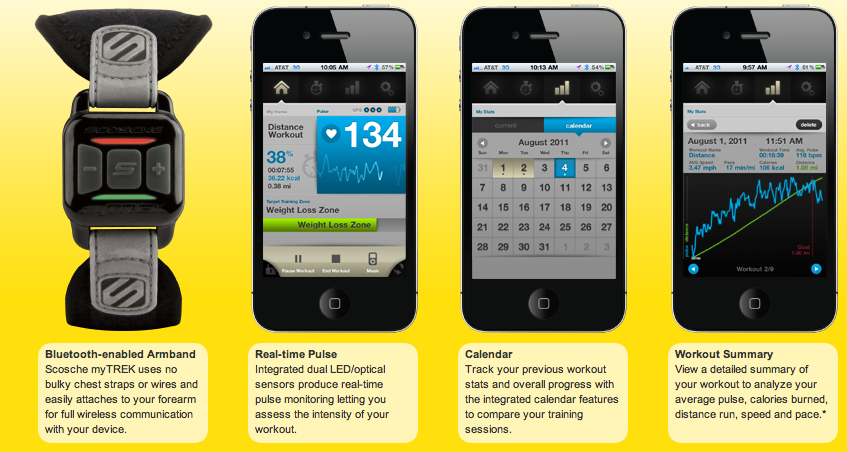
Scosche myTREK Wireless Pulse monitor

Scosche myTREK Wireless Pulse monitor for iPod and iPhone is one of the newest activity monitors on the market but this one is not relying just on accelerometer data but going back to heart rate monitoring, except this time it is a forearm worn device instead of a chest strap. I am very interested in seeing how the built-in accelerometer filters into total activity energy expenditure. That fact alone is a potential limitation of other arm-worn devices. Price $129.99

WIBC (Wouldn't It Be Cool)- If they could leverage this technology and use a pc driven receiver to monitor more than one device at a time, we might have a killer app/ tech solution for monitoring fitness in schools and gyms (think Suunto, Activio, Polar, Zwphyr, and Ekho's group monitoring solutions).


Click here to explore more of ExerGame Lab's archived posts involving activity monitors.

[Via Kinetic Shift]

Friday, August 12, 2011

NewYu


NewYu collage

Getting to the state of being the "New You" is often a goal we seek and even the description of this blog is "Where gaming and technology collide for a healthier you!"  This new device (NewYu) is pushing its way onto the busy scene of ubiquitous and pervasive activity-monitors that are user-friendly and intend to impact behavioral outcomes such as physical activity, exercise and nutritional habits.

Click here to explore more of ExerGame Lab's archived posts involving other activity monitors. 

Using industry-first motion detection and advanced pattern recognition technology that detects and identifies specific body movements, the small and lightweight NewYu easily clips anywhere on the torso or to the pocket. The monitor not only tracks basic activities such as walking and running, but also specifically recognizes complex movements like biking, elliptical and step machine, while also capturing data for daily living tasks like cooking, cleaning and shopping. The result – a more accurate view of how many calories are burned based on every movement made throughout the day.
I am interested in seeing how accurate this graphic is in terms of unique features beyond heart rate monitors, armbands and other devices. Considering the app is Android only, they've got to be preparing at least an iOS app in the near future.  Once I get a hold of one, I will let you know how it works and if might be something schools could use.


[Via Kinetic Shift]

Monday, August 8, 2011

Treadmill training (run-simulator) - Outside Interactive

Stay at home and train for the big race on your TV, computer and treadmill [Via Techland]


Whether your pounding the miles for the Boston Marathon or want to hit the Summertime Run in Central Park 10K, the videos intend to give you a feel for the course you'll be on before you're on them.  They even come with "pop-up" style pictures of landmark signs like the one for the Boathouse in Central Park (see screenshot).


Not an exergame but definitely using tech to mediate exercise - in this case using a foot pod to track speed, cadence although if you approach a hill, I don't think the treadmill is tied to the Virtual reality software to increase the incline of your treadmill.  The PC simulator will advise you what setting to adjust your treadmill to approximate the hill.  I know I'd probably adjust for the first few hills, but after that I probably wouldn't.  Woud you keep the suggested pace?
 Check them out -http://twitter.com/#!/OInteractive


If you can't hack a 10 minute mile, the company Outside Interactive suggest you go to the pre-paced DVDs where you can adjust the speed of the footage to match your cadence.


Outside Interactive - Virtual Runner - 90 Second Spot from Gary McNamee on Vimeo.

Outside Interactive - Summertime Run - Central Park - 10K from Gary McNamee on Vimeo.
And for an extra shot of realism, the company is getting set to release its "Virtual Runner" software next month, which consists of a $250 sneaker sensor and computer software that can match the pace of the video to the pace that you're running on the treadmill. The videos will instruct you to adjust the incline on your treadmill to match hilly parts of the courses, too.
Click here to explore more of ExerGame Lab's archived posts involving simulators.

Virtual Relay Exergame

This concept of a connected and social physical experience mediated by technology certainly has lots of exergame potential especially if they end up building in ARG, leader-boards, and game elements.

Virtual relay - DesignBlizzard


How it works
The V.relay is a baton for virtual relays. By connecting and joining to a community website, you could search for relays of your interest, the time you want to start, the team you want to join.
The baton receives the data from the computer and gives a signal when it's time for your turn to run in the team. The GPS signal lets the relay continue on virtually all around the world. And also gives you feedback of the distance/time/heartbeat rate/runners left during your run.
The main aspect or the V.relay is to give people more motivation for exercise by making them feel connected.

Enter your email address:

Delivered by TinyLetter