Just saw this video and grabbed a screenshot of a simulated(?) #exergame of a child doing rehab on leg/knee. Does anyone know if this program already exists?
Click here to explore more of ExerGame Lab's archived posts involving research studies.
Thursday, November 3, 2011
Sunday, October 23, 2011
Playing exergames in the classroom: Pre-service teachers’ motivation, passion, effort, and perspectives (study)
at
10/23/2011
Image by BeFitt via FlickrThis study investigated pre-service teachers’ experience, motivation, passion, effort, and perspectives in playing exergames in the classroom using the self-determination theory as the main theoretical framework. One hundred forty pre-service teachers participated in the study. A mixed method was used. Data included pre-survey and post-survey results and classroom observation notes. Findings indicated that most pre-service teachers had little prior experience in exergames. However, they enjoyed playing exergames in the classroom and considered it beneficial to incorporate exergames in teaching. They also raised concerns, challenges, and the need for resources to effectively incorporate exergames in teaching. Findings also suggested that promoting pre-service teachers’ higher levels of self-determined motivation and harmonious passion may motivate them to be more active in exergames. Details are discussed in the paper.Journal of Technology and Teacher EducationISSN 1059-7069Volume 19, Issue 3, October 2011Association for the Advancement of Computing in Education (AACE) Chesapeake, VA
Click here to explore more of ExerGame Lab's archived posts involving research studies.
Tuesday, October 18, 2011
VPA in Dance Exer-Game (study)
at
10/18/2011
Vigorous Energy Expenditure with a Dance Exer-game. JEPonline 2011;14(4):13-28.
Physical inactivity is a risk factor for heart disease, diabetes, and obesity. Efforts to increase physical activity can include active video games. While many active video games demonstrate exertion levels commensurate with light to moderate exercise, it is unclear whether these games can meet requirements for vigorous activity. The purpose of this study was to determine whether the active videovgame, Dance Dance Revolution (DDR), can provide vigorous exercise vin a wide range of adults. Twelve adults (18 to 53 yrs, BMI 18 to 37) were studied while playing DDR at an advanced level. Metabolic measures were collected during a 30 min game-play protocol at the advanced “Heavy” level of difficulty. Mean values achieved were the following: 8 METs, heart rate 157 beats·min-1, and energy expenditure 9 kcal·min-1. DDR is played similarly to that of interval type exercise where each game-song is followed by a brief rest period. Subjects reported that DDR is fun, and that the competitive nature of playing with others is enjoyable. This study found that DDR is effective in meeting vigorous physical a requirements for improving or maintaining physical fitness.
Click here to explore more of ExerGame Lab's archived posts involving research studies.
Wednesday, October 5, 2011
Exergames in ICU
at
10/05/2011
Feasibility and observed safety of interactive video games for physical rehabilitation in the intensive care unit: a case series
Background
Early rehabilitation in the intensive care unit (ICU) improves patients' physical function. Despite reports of using commercially available interactive video game systems for rehabilitation, there are few data evaluating feasibility and safety as part of routine in-patient rehabilitation, particularly in the ICU.
Methods
We conducted an observational study from September 1, 2009, to August 31, 2010, of adults admitted to a 16-bed medical ICU receiving video games as part of routine physical therapy (PT), evaluating use and indications and occurrence of 14 prospectively monitored safety events.
Results
Of 410 patients receiving PT in the medical ICU, 22 (5% of all patients; male, 64%; median age, 52 years) had 42 PT treatments with video games (median [interquartile range] per patient, 1.0 [1.0-2.0]). Main indications for video game therapy included balance (52%) and endurance (45%), and the most common activities included boxing (38%), bowling (24%), and balance board (21%). Of 42 treatments, 69% occurred while standing and 45% while mechanically ventilated. During 35 hours of PT treatment, 0 safety events occurred (95% upper confidence limit for safety event rate, 8.4%).
Conclusions
Novel use of interactive video games as part of routine PT in critically ill patients is feasible and appears safe in our case series. Video game therapy may complement existing rehabilitation techniques for ICU patients.
Keywords: Rehabilitation; Critical care; Adults; Mechanical ventilation; Interactive video games
Michelle E. Kho PT, PhD, Abdulla Damluji MBChB, MPH, Jennifer M. Zanni PT, MSPT, ScD, Dale M. Needham MD, PhD
Click here to explore more of ExerGame Lab's archived posts involving research studies.
Background
Methods
We conducted an observational study from September 1, 2009, to August 31, 2010, of adults admitted to a 16-bed medical ICU receiving video games as part of routine physical therapy (PT), evaluating use and indications and occurrence of 14 prospectively monitored safety events.
Results
Of 410 patients receiving PT in the medical ICU, 22 (5% of all patients; male, 64%; median age, 52 years) had 42 PT treatments with video games (median [interquartile range] per patient, 1.0 [1.0-2.0]). Main indications for video game therapy included balance (52%) and endurance (45%), and the most common activities included boxing (38%), bowling (24%), and balance board (21%). Of 42 treatments, 69% occurred while standing and 45% while mechanically ventilated. During 35 hours of PT treatment, 0 safety events occurred (95% upper confidence limit for safety event rate, 8.4%).
Conclusions
Novel use of interactive video games as part of routine PT in critically ill patients is feasible and appears safe in our case series. Video game therapy may complement existing rehabilitation techniques for ICU patients.
Keywords: Rehabilitation; Critical care; Adults; Mechanical ventilation; Interactive video games
Michelle E. Kho PT, PhD, Abdulla Damluji MBChB, MPH, Jennifer M. Zanni PT, MSPT, ScD, Dale M. Needham MD, PhD
Click here to explore more of ExerGame Lab's archived posts involving research studies.
Related articles
Tuesday, September 20, 2011
Tetris on DDR Pads (StepTet)
at
9/20/2011
Bravo to another great MIT crew project! I love the 6 foot LED matrix and the mash-up of games but I think a more serious workout would occur if you had to move further like on a Lightspace floor or you had to lift weights while playing like in Tetris Weightlifting.
Tetris Game Controlled with DDR Pads, DDT is Born - Technabob:
'via Blog this'
Tetris Game Controlled with DDR Pads, DDT is Born - Technabob:
'via Blog this'
Monday, August 15, 2011
Scosche myTREK Wireless Pulse monitor
at
8/15/2011
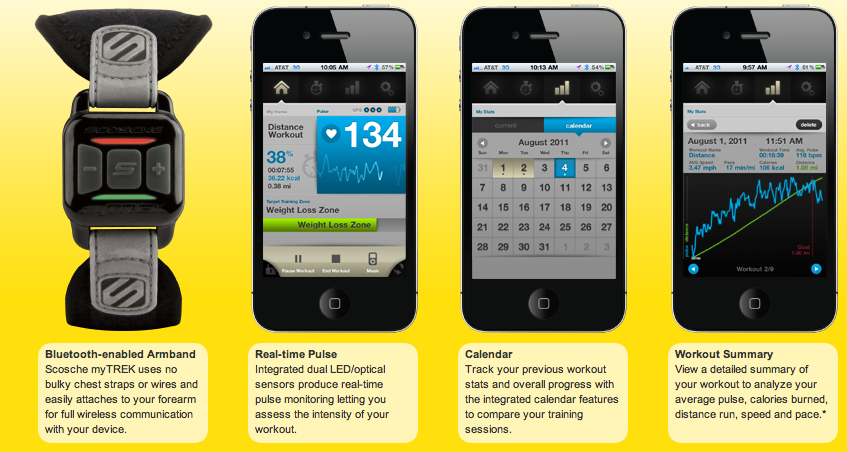
Scosche myTREK Wireless Pulse monitor for iPod and iPhone is one of the newest activity monitors on the market but this one is not relying just on accelerometer data but going back to heart rate monitoring, except this time it is a forearm worn device instead of a chest strap. I am very interested in seeing how the built-in accelerometer filters into total activity energy expenditure. That fact alone is a potential limitation of other arm-worn devices. Price $129.99
WIBC (Wouldn't It Be Cool)- If they could leverage this technology and use a pc driven receiver to monitor more than one device at a time, we might have a killer app/ tech solution for monitoring fitness in schools and gyms (think Suunto, Activio, Polar, Zwphyr, and Ekho's group monitoring solutions).
Click here to explore more of ExerGame Lab's archived posts involving activity monitors.
[Via Kinetic Shift]
WIBC (Wouldn't It Be Cool)- If they could leverage this technology and use a pc driven receiver to monitor more than one device at a time, we might have a killer app/ tech solution for monitoring fitness in schools and gyms (think Suunto, Activio, Polar, Zwphyr, and Ekho's group monitoring solutions).
Click here to explore more of ExerGame Lab's archived posts involving activity monitors.
[Via Kinetic Shift]
Subscribe to:
Posts (Atom)