Friday, February 24, 2012

Will Nike+'s Gamification of Workout(s)?


new nike plus 01
Nike+ (Nike+ Pressure Sensors) is adding more gear to those things we used to call sneakers. These new pressure sensors and accelerometers will be mounted inside specific hoops and cross-training shoes with all the data being fed back to your iPhone via Bluetooth.

new nike plus 02
The new shoes feature four embedded sensors – in the toe, heel, ball and outer foot, with an internal accelerometer so that the measured movement is more precise. 


Besides tracking sports specific data wirelessly one of the features they are hoping to catch on is the use of leaderboards and the ability to share your stats with your friends to see who is the fastest, jumps the highest, etc.. In many ways we've done these activities to see who can throw the farthest or run the fastest, but these new tools will give all users so much more information about your performance and what I love about it is the long term tracking of skill and health related fitness - one area schools are not particularly good at.

Concerns
Having all students use and own Nike +, a specific shoe, and iPhone is unreasonable....well maybe not to Nike and Apple... but I love the potential health informatics data collection side of this new product. I alsp have concerns because I know I have a hard time wearing Nike shoes because of my foot prontation, wide feet, and  Nike typically designs for narrower feet. What other concerns do you foresee for this system or how might you use this with your group, school, family?


new nike plus 03

Shoes with the new  will be available starting June 29th, 2012. You’ll find the new features available in the Nike Hyperdunk+ basketball shoe, and the Lunar Hyperworkout+ for women and Lunar TR1+ for men.

[via CoolHunting and Nike+ Steps Up Its Game with Pressure Sensors and Accelerometers:]


Tuesday, February 21, 2012

Fitness Monitoring for the Classroom

New Fitness Monitoring for the Classroom:
Interactive Health Technologies announced that it was partnering with Sony to provide the NFC Dynamic Tag (FeliCa Plug) in the Spirit System, which is now available to schools across America.

With this fitness monitoring is streamlined with a classroom management system for teachers, and in turn enhances the overall PE experience with students. From a simple tap of a Spirit Heart Rate Monitor student information can be automatically transferred to and tracked on the Spirit System through NFC/FeliCa contractless communication. The system effectively measures each student’s cardio activity allowing educators to evaluate the student’s physical activity and endurance.
“The crisis of childhood obesity we collectively face in our nation demands innovative, new solutions,” says Jen Ohlson, Founder of Interactive Health Technologies. The IHT Spirit System with Sony NFC Dynamic Tag uses technology to motivate children to develop healthy habits that will last a lifetime, a PE and fitness model for the 21st Century.”

It's great to see big groups start to put solutions together for NFC and other health IT initiatives, however I do see problems with the traditional HRM as it is uncomfortable to wear all day. I am really pleased to see the many wrist watch, ring and other devices out there that can be worn all day much more unobtrusively.

Games for Health Journal

Games for Health Journal: Research, Development, and Clinical Applications - is now live and online at http://online.liebertpub.com/G4H

Here are a couple of the great exergaming articles from this first issue:


Enhanced by Zemanta

Thursday, November 3, 2011

Kinect Rehab Exergame

Just saw this video and grabbed a screenshot of a simulated(?) #exergame of a child doing rehab on leg/knee.  Does anyone know if this program already exists?


Click here to explore more of ExerGame Lab's archived posts involving research studies. 

Sunday, October 23, 2011

Playing exergames in the classroom: Pre-service teachers’ motivation, passion, effort, and perspectives (study)

Pulse Booth @ LIWImage by BeFitt via FlickrThis study investigated pre-service teachers’ experience, motivation, passion, effort, and perspectives in playing exergames in the classroom using the self-determination theory as the main theoretical framework. One hundred forty pre-service teachers participated in the study. A mixed method was used. Data included pre-survey and post-survey results and classroom observation notes. Findings indicated that most pre-service teachers had little prior experience in exergames. However, they enjoyed playing exergames in the classroom and considered it beneficial to incorporate exergames in teaching. They also raised concerns, challenges, and the need for resources to effectively incorporate exergames in teaching. Findings also suggested that promoting pre-service teachers’ higher levels of self-determined motivation and harmonious passion may motivate them to be more active in exergames. Details are discussed in the paper.


Journal of Technology and Teacher EducationISSN 1059-7069Volume 19, Issue 3, October 2011Association for the Advancement of Computing in Education (AACE)  Chesapeake, VA


Click here to explore more of ExerGame Lab's archived posts involving research studies. 
Enhanced by Zemanta

Tuesday, October 18, 2011

VPA in Dance Exer-Game (study)

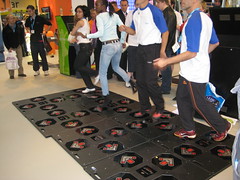
Festival du jeu vidéo 2008 (video game festiva...Image via WikipediaHere's a new article invloving adults playing from the ADAM lab on Long Island


Vigorous Energy Expenditure with a Dance Exer-game. JEPonline  2011;14(4):13-28. 

Physical inactivity is a risk factor for heart disease, diabetes, and obesity. Efforts to increase physical activity can include active video games. While many active video games demonstrate exertion levels commensurate with light  to moderate exercise, it is unclear whether these games can meet requirements for vigorous activity. The purpose of this study was to determine whether the active videovgame, Dance Dance Revolution (DDR), can provide vigorous exercise vin a wide range of adults. Twelve adults (18 to 53 yrs, BMI 18 to 37) were studied while  playing DDR at an advanced level. Metabolic measures were collected during a 30  min game-play protocol  at the advanced  “Heavy” level of difficulty.  Mean values achieved were the following: 8 METs, heart rate 157 beats·min-1, and energy expenditure 9  kcal·min-1.  DDR is played similarly to that of interval type exercise where  each game-song is followed by a brief rest period. Subjects reported that  DDR  is fun, and that the competitive nature of playing with  others is enjoyable. This  study found that DDR is effective in meeting vigorous physical a requirements  for improving or maintaining physical fitness.


Click here to explore more of ExerGame Lab's archived posts involving research studies. 
Enhanced by Zemanta

Enter your email address:

Delivered by TinyLetter