Sunday, June 10, 2012

Does #exergame experience impact movement quantity and quality? (study)

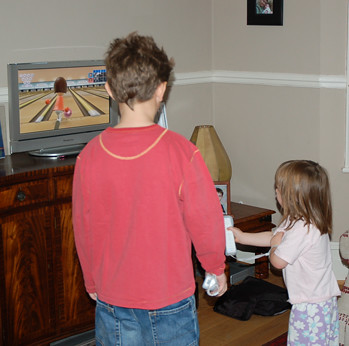
I often wonder if previous experience in playing an #exergame impacts the overall experience and success of game play. Levac et al. also wanted to know whether motivation to succeed at the game impacted movement characteristics (quality and quantity) in children. Using force plate data while playing Wii Sports and Wii Fit #exergames, participants who had previous experience playing Wii Fit moved more than those without experience. As they also concluded, if exergames are to be used as a modality in rehab settings or as  an educational tool, its important to sequence positive learning experiences to improve game performance as well as self-efficacy.

Levac D, Pierrynowski MR, Canestraro M, Gurr L, Leonard L, & Neeley C (2010). Exploring children's movement characteristics during virtual reality video game play. [Exergame] Human movement science PMID: 20724014

Lots more news and footage will be coming out next week from the Games for Health Conference in Boston.


Additional Games for Health Keynotes!
Constance Steinkuehler Squire, senior policy analyst for the White House Office of Science and Technology Policy, will discuss the opportunities for videogames to address national challenges, including those in health, health care, and biotechnology.
Bill Crounse, MD, senior director of worldwide health for Microsoft, will present “Connecting & Kinecting Health and Health Care,” which will explore how Microsoft and its partners are merging its information and game technologies to create global solutions for personal health and professional health care.
Jane McGonigal, New York Times bestselling author and co-founder of SuperBetter Labs, will highlight the design and release of SuperBetter, a game-based social application designed to help people boost personal resilience and lead healthier, longer, and more positive lives.
Jay Walker, curator and chairman of TEDMED, a global community of people who passionately believe that the future of health and medicine is here, will provide the end-of-conference special guest keynote: “Gaming the System”.
About Games for Health
Founded in 2004, the Games for Health Project supports the development of the health games community, champions efforts to mainstream health games, and brings together researchers, medical professionals, and game developers to share information about the impact games and game technologies can have on health, health care, and policy. The Pioneer Portfolio of the Robert Wood Johnson Foundation is a major supporter of both the Games for Health Project and its annual Games for Health Conference.
About the Robert Wood Johnson Foundation and its Pioneer Portfolio
The Robert Wood Johnson Foundation focuses on the pressing health and health care issues facing the United States. As the nation’s largest philanthropy devoted exclusively to improving the health and health care of all Americans, the Foundation works with a diverse group of organizations and individuals to identify solutions and achieve comprehensive, meaningful and timely change. Projects in the Pioneer Portfolio are future-oriented and look beyond conventional thinking to explore solutions at the cutting edge of health and healthcare. For more information, visit www.rwjf.org/pioneer.


Saturday, June 9, 2012

Is Wii Fit as Good as Normal MS Rehab? #Exergame Study

A total of 80 participants over a six-week #exergaming intervention (12 supervised 30-min sessions) performed as well as the traditional group on several balance tests. The effect sizes for the TUG, TUGcognitive and, the Dynamic Gait Index (DGI) measures were moderate but there were statistically significant improvements for the #exergame Wii Fit group on  all measures.

Click here to explore more of ExerGame Lab's archived posts involving research studies. 

I know there's been a lot of press (or at least tweets) that pile on the poor effects of exergaming to improve fitness and health outcomes but with every study its important to be able to dissect the strengths and weaknesses. In the case of the current study, although there was no significant difference between the exergaming and traditional groups, that's actually a good indicator that it was as effective and both groups saw modest gains after 6-7 weeks of treatments.

Nilsagard, Y., Forsberg, A., & von Koch, L. (2012). Balance exercise for persons with multiple sclerosis using Wii games: a randomised, controlled multi-centre study Multiple Sclerosis Journal DOI: 10.1177/1352458512450088


Lots more news and footage will be coming out next week from the Games for Health Conference in Boston.

Additional Games for Health Keynotes!
Constance Steinkuehler Squire, senior policy analyst for the White House Office of Science and Technology Policy, will discuss the opportunities for videogames to address national challenges, including those in health, health care, and biotechnology.
Bill Crounse, MD, senior director of worldwide health for Microsoft, will present “Connecting & Kinecting Health and Health Care,” which will explore how Microsoft and its partners are merging its information and game technologies to create global solutions for personal health and professional health care.
Jane McGonigal, New York Times bestselling author and co-founder of SuperBetter Labs, will highlight the design and release of SuperBetter, a game-based social application designed to help people boost personal resilience and lead healthier, longer, and more positive lives.
Jay Walker, curator and chairman of TEDMED, a global community of people who passionately believe that the future of health and medicine is here, will provide the end-of-conference special guest keynote: “Gaming the System”.
About Games for Health
Founded in 2004, the Games for Health Project supports the development of the health games community, champions efforts to mainstream health games, and brings together researchers, medical professionals, and game developers to share information about the impact games and game technologies can have on health, health care, and policy. The Pioneer Portfolio of the Robert Wood Johnson Foundation is a major supporter of both the Games for Health Project and its annual Games for Health Conference.
About the Robert Wood Johnson Foundation and its Pioneer Portfolio
The Robert Wood Johnson Foundation focuses on the pressing health and health care issues facing the United States. As the nation’s largest philanthropy devoted exclusively to improving the health and health care of all Americans, the Foundation works with a diverse group of organizations and individuals to identify solutions and achieve comprehensive, meaningful and timely change. Projects in the Pioneer Portfolio are future-oriented and look beyond conventional thinking to explore solutions at the cutting edge of health and healthcare. For more information, visit www.rwjf.org/pioneer.

Friday, June 8, 2012

Stomp the Mole: Encouraging Movement via iOS #Exergame

Using existing hardware to encourage physical activity is a smart and simple way to harness existing technology and familiar concepts . Take for example neerajjadhav87's school project that used an iOS camera (iPhone, iPod Touch) to play a "Stomp the Mole" augmented reality-type game. It's interesting because six months ago latino1990's STOMP DAH MOLE concept video basically foreshadows the newer project. I say do whatever means necessary to increase awareness and opportunities to increase physical activity and engage in the physical world.

Stomp the mole: IPhone and IPod touch exergame - YouTube:

Lots more news and footage will be coming out next week from the Games for Health Conference in Boston.


Additional Games for Health Keynotes!
Constance Steinkuehler Squire, senior policy analyst for the White House Office of Science and Technology Policy, will discuss the opportunities for videogames to address national challenges, including those in health, health care, and biotechnology.

Bill Crounse, MD, senior director of worldwide health for Microsoft, will present “Connecting & Kinecting Health and Health Care,” which will explore how Microsoft and its partners are merging its information and game technologies to create global solutions for personal health and professional health care.

Jane McGonigal, New York Times bestselling author and co-founder of SuperBetter Labs, will highlight the design and release of SuperBetter, a game-based social application designed to help people boost personal resilience and lead healthier, longer, and more positive lives.


Jay Walker, curator and chairman of TEDMED, a global community of people who passionately believe that the future of health and medicine is here, will provide the end-of-conference special guest keynote: “Gaming the System”.


About Games for Health
Founded in 2004, the Games for Health Project supports the development of the health games community, champions efforts to mainstream health games, and brings together researchers, medical professionals, and game developers to share information about the impact games and game technologies can have on health, health care, and policy. The Pioneer Portfolio of the Robert Wood Johnson Foundation is a major supporter of both the Games for Health Project and its annual Games for Health Conference.


About the Robert Wood Johnson Foundation and its Pioneer Portfolio
The Robert Wood Johnson Foundation focuses on the pressing health and health care issues facing the United States. As the nation’s largest philanthropy devoted exclusively to improving the health and health care of all Americans, the Foundation works with a diverse group of organizations and individuals to identify solutions and achieve comprehensive, meaningful and timely change. Projects in the Pioneer Portfolio are future-oriented and look beyond conventional thinking to explore solutions at the cutting edge of health and healthcare. For more information, visit www.rwjf.org/pioneer.

Case Study of a Girls Physical Activity #Exergaming Program with Pokewalker

Congrats to Dr. Yoonsin Oh who just successfully defended her dissertation from the University of Wisconsin in Madison. The title of her dissertation is A CASE STUDY OF A GIRLS’ EXERGAMING PHYSICAL ACTIVITY PROGRAM. The above image is from a poster from Midwestern AAHPHERD.

She will be in Boston next week at the Games for Health Conference 2012. If you see her, please congratulate her on this big step. Her twitter handle @yoonsinoh

Click here to explore more of ExerGame Lab's archived posts involving research studies. 


Can Rehab with Wii Fit improve older adults' balance? #Exergaming Intervention

Dr. Abe Rendon's dissertation paper just popped up and it's focus is a 6-week randomized control trial on 40 older adults dynamic balance.Using Wii Fit as the intervention participants improved on two of the balance tests including 8-foot Up & Go test [median decrease of 1.0 versus -0.2 s, (P = 0.038) and the Activities-specific Balance Confidence Scale (6.9 versus 1.3%) (P = 0.038)]. I love this conclusion: "virtual reality gaming provides clinicians with a useful tool for improving dynamic balance and balance confidence in older adults." Well done Dr.Abe!
Rendon AA, Lohman EB, Thorpe D, Johnson EG, Medina E, & Bradley B (2012). The effect of virtual reality gaming on dynamic balance in older adults. Age and ageing PMID: 22672915

Click here to explore more of ExerGame Lab's archived posts involving research studies. 

Dr.Abe's dissertation can be found here

Lots more research and applications at the upcoming Games for Health Conference in Boston.


Additional Games for Health Keynotes!
Constance Steinkuehler Squire, senior policy analyst for the White House Office of Science and Technology Policy, will discuss the opportunities for videogames to address national challenges, including those in health, health care, and biotechnology.

Bill Crounse, MD, senior director of worldwide health for Microsoft, will present “Connecting & Kinecting Health and Health Care,” which will explore how Microsoft and its partners are merging its information and game technologies to create global solutions for personal health and professional health care.

Jane McGonigal, New York Times bestselling author and co-founder of SuperBetter Labs, will highlight the design and release of SuperBetter, a game-based social application designed to help people boost personal resilience and lead healthier, longer, and more positive lives.


Jay Walker, curator and chairman of TEDMED, a global community of people who passionately believe that the future of health and medicine is here, will provide the end-of-conference special guest keynote: “Gaming the System”.


About Games for Health
Founded in 2004, the Games for Health Project supports the development of the health games community, champions efforts to mainstream health games, and brings together researchers, medical professionals, and game developers to share information about the impact games and game technologies can have on health, health care, and policy. The Pioneer Portfolio of the Robert Wood Johnson Foundation is a major supporter of both the Games for Health Project and its annual Games for Health Conference.


About the Robert Wood Johnson Foundation and its Pioneer Portfolio
The Robert Wood Johnson Foundation focuses on the pressing health and health care issues facing the United States. As the nation’s largest philanthropy devoted exclusively to improving the health and health care of all Americans, the Foundation works with a diverse group of organizations and individuals to identify solutions and achieve comprehensive, meaningful and timely change. Projects in the Pioneer Portfolio are future-oriented and look beyond conventional thinking to explore solutions at the cutting edge of health and healthcare. For more information, visit www.rwjf.org/pioneer.

Thursday, June 7, 2012

Can You Learn to Surf Without Water? Try the iSurf Simulator #Exergame


i-Surfsimulators – who have been making surfing simulations since 1992 in Hawaii – announced the launch of a portable event exergame system that provides virtual “waterless” surfing, including two-player-on-screen interactive games. iSurf Simulators: Surf's Up!

Exergaming Points to Ponder (ExP2P)
  • I think any game is more immersive given the right conditions and environment. Take for example the authentic board to play on increases the realism. The larger screen or projector gives you a more visually appealing interface. And realistic and loud ambient sounds and feedback to provide knowledge of results and performance. These factors combined with the gameplay elements greatly impact user experience (UX) and thus the likelihood that it might be repeated in the future.
i-Surfsimulators Official Website

Click here to explore more of ExerGame Lab's archived posts involving simulators.


The 8th Annual Games for Health Conference in Boston, MA at the Hyatt Harboside Hotel is June 12-14 -- under one month away!
Register today at: http://www.regonline.com/gbew2012


Additional Games for Health Keynotes!
Constance Steinkuehler Squire, senior policy analyst for the White House Office of Science and Technology Policy, will discuss the opportunities for videogames to address national challenges, including those in health, health care, and biotechnology.

Bill Crounse, MD, senior director of worldwide health for Microsoft, will present “Connecting & Kinecting Health and Health Care,” which will explore how Microsoft and its partners are merging its information and game technologies to create global solutions for personal health and professional health care.

Jane McGonigal, New York Times bestselling author and co-founder of SuperBetter Labs, will highlight the design and release of SuperBetter, a game-based social application designed to help people boost personal resilience and lead healthier, longer, and more positive lives.


Jay Walker, curator and chairman of TEDMED, a global community of people who passionately believe that the future of health and medicine is here, will provide the end-of-conference special guest keynote: “Gaming the System”.


About Games for Health
Founded in 2004, the Games for Health Project supports the development of the health games community, champions efforts to mainstream health games, and brings together researchers, medical professionals, and game developers to share information about the impact games and game technologies can have on health, health care, and policy. The Pioneer Portfolio of the Robert Wood Johnson Foundation is a major supporter of both the Games for Health Project and its annual Games for Health Conference.


About the Robert Wood Johnson Foundation and its Pioneer Portfolio
The Robert Wood Johnson Foundation focuses on the pressing health and health care issues facing the United States. As the nation’s largest philanthropy devoted exclusively to improving the health and health care of all Americans, the Foundation works with a diverse group of organizations and individuals to identify solutions and achieve comprehensive, meaningful and timely change. Projects in the Pioneer Portfolio are future-oriented and look beyond conventional thinking to explore solutions at the cutting edge of health and healthcare. For more information, visit www.rwjf.org/pioneer.

Enter your email address:

Delivered by TinyLetter