Tuesday, October 2, 2012

Wii Will Make You Happy to Exercise (Study)

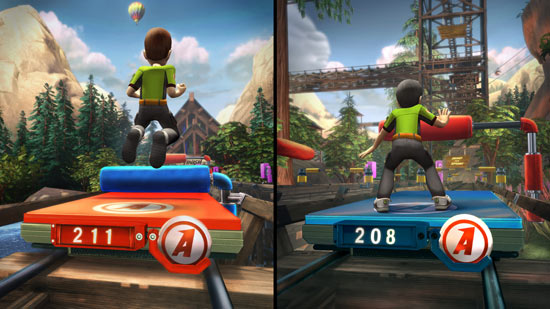
Can playing (or observing) exergames like Kinect or Wii improve your mood and make it more likely for you to exercise in the future? Those are the questions Drs. Chater and Marsden asked in the recent presentation in Liverpool. They found that those who played positively increased their mood, and in their beliefs about how much control they had in doing more exercise in the future.

This makes sense as in most games, they are usually fun to watch and play and plus if you know that you're getting a good workout while you're having fun, it is likely to improve your mood and future intention to exercise. I've found similar things in my research with teenagers,children, and college students.
New research has also shown the health benefits of exergaming showed that it can be useful in also be useful in improving balance (Vernadakis et al. 2012), coordination (Deutsch et al. 2011) and cognitive functioning (Anderson-Hanley et al, 2012; Best, 2011; O’Leary, 2011; Staiano, Abraham, & Calvert, 2012 ). Other research has shown that playing games that can elicit higher levels of intensity can improve endothelial function (Murphy et al., 2009) and higher math scores (Gao & Mandryk, 2012)
Exergaming Points to Ponder (P2P)

  • Which Wii and Kinect games did they play?
  • Were they experienced in either of them? Could prior experience and skill have affected the results?
  • Were they monitored for exercise intensity of perceived exertion? 
  • Were they assessed for level of fitness or level of daily physical activity?

Chater, A, & Marsden, B (2012). Investigating the influence of interactive game consoles on physical activity motivation & mood: Wii vs Kinect 2012 Division of Health Psychology Annual Conference
Click here to explore more of ExerGame Lab's archived posts involving research studies. 

Background: This study aimed to assess whether the Theory of Planned Behaviour (TPB) can predict physical activity (PA) intentions and whether PA is influenced by mood and past behaviour. It further looked at the effect of physically active game consoles on these variables. 

Method: The study employed a randomized, repeated-measures design with 120 participants (40 per cent males; Mean age = 29.03; [SD=12.25]). The TPB variables (attitude, subjective norm and perceived behavioural control: PBC), past behaviour and PA importance were measured along with mood using the PANAS-X. The Nintendo Wii (Tennis – competitive game) and Microsoft Xbox-Kinect (Adventures – team game) consoles were used as the intervention tools.

Findings: Multiple regression confirmed the TPB to be a strong model in predicting PA intentions explaining 58 per cent of the variance with behavioural importance explaining 18 per cent. MANCOVA revealed significant intervention effects, with an increase in PA intentions , PBC and positive affect  and a significant reduction in negative affect  after the intervention. Actual game play enhanced these variables more so than observing others playing the consoles. The type of game (competitive vs team) and console played (Wii vs Kinect) had no significant effect. 

Discussion: This study provides further support for the efficacy of the TPB in predicting physical activity intentions. Moreover, it confirms that engaging in PA through a games console can encourage beliefs in behavioural control, along with mood and motivation to be physically active, supporting their use in this setting. Future interventions should take this evidence into consideration.

Monday, October 1, 2012

Does playing Solo or Vs make a Difference in Kinect or Wii? (Study)

If you thought yes, "you are correct Sir!" According to the current study, playing Xbox Kinect™ Reflex Ridge resulted in a 1 MET higher rating than Wii Sports Boxing, and playing multiplayer yielded a 0.5 MET increase compared to solo play.
C. O’Donovan, E. Hirsch, E. Holohan, I. McBride, R. McManus, & J. Hussey (2012). Energy expended playing Xbox Kinect™ and Wii™ games: a preliminary study comparing single and multiplayer modes Physiotherapy, 98 (3), 224-229 DOI: 10.1016/j.physio.2012.05.010
Exergames have the potential to provide a novel physical activity choice for adolescents that increases energy expenditure and elicit cardiovascular responses related to health (Graf, Pratt, Hester, Short, 2009, Lanningham-Foster, Jensen, Foster, Redmond et al, 2009, Mellecker, McManus, 2008, Murphy et al. 2009).
Graf DL, Pratt LV, Hester CN, & Short KR (2009). Playing active video games increases energy expenditure in children. Pediatrics, 124 (2), 534-40 PMID: 19596737

Lanningham-Foster L, Foster RC, McCrady SK, Jensen TB, Mitre N, & Levine JA (2009). Activity-promoting video games and increased energy expenditure. The Journal of pediatrics, 154 (6), 819-23 PMID: 19324368

Mellecker RR, & McManus AM (2008). Energy expenditure and cardiovascular responses to seated and active gaming in children. Archives of pediatrics & adolescent medicine, 162 (9), 886-91 PMID: 18762609

Murphy EC, Carson L, Neal W, Baylis C, Donley D, & Yeater R (2009). Effects of an exercise intervention using Dance Dance Revolution on endothelial function and other risk factors in overweight children. International journal of pediatric obesity : IJPO : an official journal of the International Association for the Study of Obesity, 4 (4), 205-14 PMID: 19922034

Exergaming Points to Ponder (P2P)

  • Should they have played the same versions of games on both Wii and Kinect to  make a better comparison?
  • They should have played Kinect Sports Boxing to make an easier comparison.
  • I wonder what co-playing results would look like. 
  • I still haven't seen the study yet so I can't tell if it was versus (at same time - synchronous) or versus (take your own tine-asynchronous)


Click here to explore more of ExerGame Lab's archived posts involving research studies. 


Objectives
It has been reported that a higher galvanic skin response is seen when playing video games against another human player than when playing alone, which suggests increased effort. The objectives of this study were to compare energy expenditure when playing two popular active video game consoles, and to compare energy expenditure when playing in single and multiplayer modes.
Design
Crossover trial with randomised playing order.
ParticipantsFourteen healthy adults with a mean age of 21 [standard deviation (SD) 3] years.
Methods and interventionsEnergy expenditure was measured using an indirect calorimeter at rest, during 10 minutes of play on Xbox Kinect™ Reflex Ridge in both single and multiplayer modes, and during 10 minutes of play on Wii™ Sports Boxing in both single and multiplayer modes.
Main outcome measures
Metabolic equivalents (METs), heart rate, oxygen consumption and kilocalories expended.
Results
The energy expenditure during all gaming conditions was of a light intensity. Playing on the Xbox Kinect elicited greater energy expenditure than playing on the Wii [mean difference = 0.9 METs, 95% confidence interval (CI) 0.2 to 1.5]. Playing games in multiplayer mode led to greater energy expenditure (mean difference = 0.5 METs, 95% CI 0.1 to 0.9) and heart rate (mean difference = 7.9 beats/minute, 95% CI 2.0 to 13.8) than playing in single player mode.
Conclusions
No gaming condition required moderate-intensity activity in this group of young healthy adults. Potential explanations for the difference in energy expenditure seen between consoles and modes are discussed.
Keywords
Video games; Energy expenditure; Metabolic equivalent, exergame


25% of Youth Exergame! Do You? (Study)

According to the latest findings published in Pediatrics this morning, about 25% of youth play exergames, twice per week on average, for  about 50 minutes each bout and with 73% of exergamers playing them at a moderate (MPA) or vigorous intensity (VPA).

Erin K. O’Loughlin,, Erika N. Dugas, Catherine M. Sabiston, & Jennifer L. O’Loughlin (2012). Prevalence and Correlates of Exergaming in Youth Pediatrics : doi: 10.1542/peds.2012-0391
These levels are quite a bit higher than the figures we reported a few years ago (average 25 minutes), but this makes sense as popularity of motion gaming has exploded since then. Given the current figures (number of units produced) of the newest generation of camera-based controllers including Xbox Kinect and Playstation Move are 19 and 10.5 millions units respectively (Matthews, 2012; Moriarty, 2012) it seems evident that the games industry has mbraced this new wave of activity-based video games.
Yang, S.P., Treece, J.L, Miklas, C, & Graham, G (2009). Physical activity, sedentary, and exergaming time in a PEP school Research Quarterly for Exercise and Sport , 80 (1(Supplement))
Click here to explore more of ExerGame Lab's archived posts involving research studies. 

OBJECTIVES: Less than 15% of children and adolescents participate regularly in physical activity (PA) and, with ever-increasing obesity, strategies to improve PA levels in youth are urgently needed. Exergaming offers a PA alternative that may be especially attractive in our increasingly technophilic society. However, there are no observational studies of exergaming in population-based samples of adolescents. The purpose of this study was to investigate potential sociodemographic, lifestyle, psychosocial, weight-related, and mental health correlates of exergaming as well as describe the type, timing, and intensity of exergaming in a population-based sample of adolescents.

METHODS: Data on exergame use and potential sociodemographic, lifestyle, psychosocial, weight-related, and mental health correlates of exergaming were collected in mailed self-report questionnaires completed by 1241 grade 10 and 11 students from the Montreal area with a mean age of 16.8 years (SD = 0.05 years; 43% male) participating in the AdoQuest study. The independent correlates of exergaming were identified in multivariable logistic regression models.

RESULTS: Nearly one-quarter (24%) of participants reported exergaming. Exergamers played 2 days per week on average, for ∼50 minutes each bout; 73% of exergamers played at a moderate or vigorous intensity. Exergamers were more likely than nonexergamers to be girls, to play nonactive video games, to watch ≥2 hours of television per day, to be stressed about weight, and to be nonsmokers.

CONCLUSIONS: Many adolescents exergame at intensity levels that could help them achieve current moderate-to-vigorous PA recommendations. Interventions that encourage exergaming may increase PA and decrease sedentary behavior in select youth subgroups, notably in girls.

Thursday, September 27, 2012

Kinect Boxing and Dance Central Exergames Burn Em Up (Study)


Using the latest in exergaming equipment including the Kinect sensor, we have the ability to free the game player up from holding any game controllers and move more naturally. Smallwood and colleagues had children play two Kinect games (Sports Boxing and Dance Central) for 15 minutes. As expected, Boxing was more strenuous than Dance Central but unlike other studies, the intensities were only of moderate and light intensities respectively. 

Exergaming Points to Ponder (P2P)
  • What was the RPE was for each condition? 
  • What (if any) did the children prefer?
  • Did they have prior experience in playing these games or using Kinect?
Smallwood, SR, Morris, MM, Fallows, SJ, & Buckley, JP (2012). Physiologic Responses and Energy Expenditure of Kinect Active Video Game Play in Schoolchildren. Archives of Pediatrics & Adolescent Medicine, 1-5 PMID: 23007801

Objective  To evaluate the physiologic responses and energy expenditure of active video gaming using Kinect for the Xbox 360.
Design  Comparison study.
Setting  Kirkby Sports College Centre for Learning, Liverpool, England.
Participants  Eighteen schoolchildren (10 boys and 8 girls) aged 11 to 15 years.
Main Exposure  A comparison of a traditional sedentary video game and 2 Kinect activity-promoting video games, Dance Central and Kinect Sports Boxing, each played for 15 minutes. Physiologic responses and energy expenditure were measured using a metabolic analyzer.
Main Outcome Measures  Heart rate, oxygen uptake, and energy expenditure.
Results  Heart rate, oxygen uptake, and energy expenditure were considerably higher (P < .05) during activity-promoting video game play compared with rest and sedentary video game play. The mean (SD) corresponding oxygen uptake values for the sedentary, dance, and boxing video games were 6.1 (1.3), 12.8 (3.3), and 17.7 (5.1) mL · min–1 · kg–1, respectively. Energy expenditures were 1.5 (0.3), 3.0 (1.0), and 4.4 (1.6) kcal · min–1, respectively.
Conclusions  Dance Central and Kinect Sports Boxing increased energy expenditure by 150% and 263%, respectively, above resting values and were 103% and 194% higher than traditional video gaming. This equates to an increased energy expenditure of up to 172 kcal · h–1 compared with traditional sedentary video game play. Played regularly, active gaming using Kinect for the Xbox 360 could prove to be an effective means for increasing physical activity and energy expenditure in children.
Click here to explore more of ExerGame Lab's archived posts involving research studies. 

Wednesday, September 26, 2012

Dragon Ball Z: Total Body Workout exergame

Getting more active has never been easier with active play video games (exergames) and this demo of the upcoming Dragon Ball Z: Total Body Workout is no exception. I thought a few screen shots of the action would capture some of the movements required to play. Watch the video on Kotaku to get a sense of the pace of the actual game.
Most of the movements seem to be upper-body and upper-limb focused and a couple spots where a jump was required. I thought there might be kicking required (given the game character threw a couple of kicks), but it doesn't look like it.

Still awaiting word on Game Modes and Combos and wondering if it will be part of FitPlay option on Xbox Live along with heart rate monitor...

[Via Kotaku]
Click here to explore more of ExerGame Lab's archived posts involving research studies. 

Saturday, September 22, 2012

Wii Balance Board Good for PD?

Abstract:
Background:Impaired postural stability places individuals with Parkinson's at an increased risk for falls. Given the high incidence of fall-related injuries within this population, ongoing assessment of postural stability is important.Objective:To evaluate the validity of the Nintendo Wii(®) balance board as a measurement tool for the assessment of postural stability in individuals with Parkinson's.Subjects:Twenty individuals with Parkinson's participated.Intervention:Subjects completed testing on two balance tasks with eyes open and closed on a Wii(®) balance board and biomechanical force platform.Main Measures:Bland-Altman plots and a two-way, random-effects, single measure intraclass correlation coefficient model were used to assess concurrent validity of centre-of-pressure data.Results:Concurrent validity was demonstrated to be excellent across balance tasks (intraclass correlation coefficients = 0.96, 0.98, 0.92, 0.94).Conclusions:This study suggests that the Wii(®) balance board is a valid tool for the quantification of postural stability among individuals with Parkinson's.

Holmes  Jenkins, Johnson AM, Hunt MA, & Clark RA (2012). Validity of the Nintendo Wii(R) balance board for the assessment of standing balance in Parkinson's disease. Clinical Rehabilitation PMID: 22960241

Enter your email address:

Delivered by TinyLetter