Saturday, February 9, 2013

Exergame Education Workshop at Dupage County Institute 2013

DSC00422
DSC00422 (Photo credit: exergamelab)
I am honoured to be a part of the Exergame Education Workshop at the Pre-Conference Dupage County Institute 2013 on Thursday February 28, 2013 at the Chicago Bulls-Sox Training Academy in Lisle, Illinois. The facility is the Premier Exergame Showroom for Exergame Fitness / Motion Fitness and houses the latest in exergaming and fitness programming for the 21st century. Equipment includes: Trazer, Makoto Sports Arena, Lightspace, Freedom Climber, Neuroactive Brain Bikes, Expresso Bikes, iDance, Motion Surface XG... and much more!

Hope to see you there!

Top Flight Speakers (not including me):

Dan Lawler, Ph.D. - Retired Principal
Stephen P. Yang, Ph.D. - SUNY Cortland College
George Velarde - California Physical Educator of the Year
Sharon Warren - Polar Electro Education
Matt Diskin - Physical Education Specialist


Download Flyer for Exergame Workshop

Click here to explore more of ExerGame Lab's archived posts involving research studies. 
Enhanced by Zemanta

Thursday, February 7, 2013

Health Moves on iOS

In the ever-crowded arena of physical activity tracking devices and apps, Apple recently released Moves and to my surprise is pretty efficient app both interface, usability, and battery consumption wise. (Moves FAQ on iTUNES)

Simply put, enable the Location feature and this turns on the GPS to locate where you are and thus if you move quickly via car, the GPS will kick in and record it as "transport" time. As I'm typing this blog piece, I believe the accelerometer is detecting my steps b/c the green icon pulses whenever I take a step. The user guide says that whenever the GPS detects very little variations in your location, it cycles down (but I can't be sure of that). Overall battery life is about the same if you have "Location" services enabled already on your device.

Although there is no game function yet, MOVES seems to be the most fluid and intuitive of the other tracking apps I've used and if they open up the API to allow game and app developers - we could really see some nicely integrated games and activities. Of course with some simple tweaking adding simple gamification features like leaderboards, achievememts and challenges, we could see a real competitor to RunKeeper, MapMyRun, and all the other fitness apps.


Stay Active and Be Well!      [Via MakeUseOf, Moves website]


Click here to explore more of ExerGame Lab's archived posts involving research studies. 

Friday, January 4, 2013

Dance Magic Saving the World

sciseekclaimtoken-5088df88b4785
 sciseekclaimtoken-5088df88b4785
There are Games for Health, Games for Change, and now there will be a Game to Save the World: Dance Magic. It's dropping on the PlayStation Network in a few days, and the object is to match the arrows like DDR. Apparently there will be PlayStation Move support but not sure if that means Playstation Eye nor how much movement will actually be required, but at least its another rhythm game  to explore.


Click here to explore more of ExerGame Lab's archived posts involving research studies. 

sciseekclaimtoken-5088df88b4785

Wednesday, December 5, 2012

Wii Fit U coming in 2013


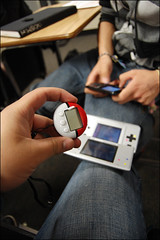
Pokewalker
Pokewalker (Photo credit: miggslives)
Linking physical activity away from an exergame or other non-mobile connected device has been a scenario that has not been explored but holds plenty of promise. As Zamzee's recent findings, having an accelerometer and access to a social network where rewards are given out based on activity levels showed a significant increase (60%) in PA than the control group that did not have access to the website. Using a new pedometer dubbed the Fit Meter (see Pokewalker for DS), Nintendo will be releasing Wii Fit U in 2013. If the device looks familiar, it should and it appears it will interface with the Wii U controller via infrared sensors like the Pokewalker did with the DS. Will U Buy It?
Enhanced by Zemanta

Self-discrepancy and regulatory fit in avatar-based exergames (Study)

Wii Fit
Wii Fit (Photo credit: Wikipedia)
Drawing from Higgins's self-discrepancy theory and regulatory focus theory, this study examined the use of activated selves and regulatory foci in health games. Utilizing the Wii's® avatar-creating and exergaming features, a 2 (activated self: actual self versus ideal self) × 2 (regulatory focus: promotion versus prevention) × 2 (efficacy appeals: self-efficacy versus response-efficacy) between-subjects experiment tested the interactions of activated selves, regulatory foci, and efficacy appeals on low-calorie dieting intentions after health game playing. Results from an experiment with 156 participants demonstrated that a fit between regulatory focus and efficacy appeals induced greater dieting intentions when the actual self was activated while the opposite effect occurred when the ideal self was activated. Theoretical contributions to basic and applied social psychology as well as managerial implications for consumer behavior research are considered.

Read More: http://www.amsciepub.com/doi/abs/10.2466/06.07.21.PR0.111.6.697-710

Click here to explore more of ExerGame Lab's archived posts involving research studies. 
Enhanced by Zemanta

Thursday, November 1, 2012

25% of Teens Play Exergames! Do You? (Study)

As posted earlier from a recent press release in Pediatrics, about 25% of youth play exergames, twice per week on average, for  about 50 minutes each bout and with 73% of exergamers playing them at a moderate (MPA) or vigorous intensity (VPA).

O'Loughlin EK, Dugas EN, Sabiston CM, & O'Loughlin JL (2012). Prevalence and Correlates of Exergaming in Youth. Pediatrics PMID: 23027171


These levels are quite a bit higher than the figures we reported a few years ago (average 25 minutes), but this makes sense as popularity of motion gaming has exploded since then. Given the current figures (number of units produced) of the newest generation of camera-based controllers including Xbox Kinect and Playstation Move are 19 and 10.5 millions units respectively (Matthews, 2012; Moriarty, 2012) it seems evident that the games industry has mbraced this new wave of activity-based video games.
Yang, S.P., Treece, J.L, Miklas, C, & Graham, G (2009). Physical activity, sedentary, and exergaming time in a PEP school Research Quarterly for Exercise and Sport , 80 (1(Supplement))


Click here to explore more of ExerGame Lab's archived posts involving research studies. 

OBJECTIVES: Less than 15% of children and adolescents participate regularly in physical activity (PA) and, with ever-increasing obesity, strategies to improve PA levels in youth are urgently needed. Exergaming offers a PA alternative that may be especially attractive in our increasingly technophilic society. However, there are no observational studies of exergaming in population-based samples of adolescents. The purpose of this study was to investigate potential sociodemographic, lifestyle, psychosocial, weight-related, and mental health correlates of exergaming as well as describe the type, timing, and intensity of exergaming in a population-based sample of adolescents.

METHODS: Data on exergame use and potential sociodemographic, lifestyle, psychosocial, weight-related, and mental health correlates of exergaming were collected in mailed self-report questionnaires completed by 1241 grade 10 and 11 students from the Montreal area with a mean age of 16.8 years (SD = 0.05 years; 43% male) participating in the AdoQuest study. The independent correlates of exergaming were identified in multivariable logistic regression models.

RESULTS: Nearly one-quarter (24%) of participants reported exergaming. Exergamers played 2 days per week on average, for ∼50 minutes each bout; 73% of exergamers played at a moderate or vigorous intensity. Exergamers were more likely than nonexergamers to be girls, to play nonactive video games, to watch ≥2 hours of television per day, to be stressed about weight, and to be nonsmokers.

CONCLUSIONS: Many adolescents exergame at intensity levels that could help them achieve current moderate-to-vigorous PA recommendations. Interventions that encourage exergaming may increase PA and decrease sedentary behavior in select youth subgroups, notably in girls.

Enter your email address:

Delivered by TinyLetter